Murder at the base of the hill

The love of a sibling is one of the purest things anyone can experience. For Dale McCauley, 44, it was the love and persistence of his sister Sandra, which would bring a confession, an end to the near two-decade search for his body, and the eventual conviction of the man who tragically cut his life short.

Nestled a comfortable seven-minute drive away from the bustling winery town of McLaren Vale is the cozy town of Willunga.

With a population of a tick under 4,000, the sleepy town is known for its cafes, community spirit, funky architecture, and its Saturday Farmers’ Markets, which are proclaimed to be some of the best in Australia.

Many holidaymakers find themselves cruising past the exit at a comfortable pace as they make their way onto the winding Willunga Hill, the beginning of the home stretch of the drive to Victor Harbor, with the seaside community playing host to nearly a million visitors annually.

Dale McCauley

Willunga, while well-known to locals of the Fleurieu Peninsula, is frequently overshadowed by its more marketable compatriots of McLaren Vale and Victor Harbor. A mysterious disappearance would thrust the town into the limelight, leaving locals, loved ones, and the South Australian Police baffled for the better part of the next two decades.

To all who knew him, Dale McCauley was an introvert who didn’t need much to be happy.

An artist, who took pleasure in noticing the finer details, Dale had just returned from Yuendumu in the Northern Territory (nearly 300km northwest of Alice Springs) when he had been running a community art centre.

With the Art Centre established and successful, Mr. McCauley rode his luck to expand his business interests. He, along with a friend, Adrian Mahony, who he had met while working at the Art Centre, who was at the time living on Mr. McCauley’s property in Willunga, jointly purchased a yacht for $14,000, with the ultimate goal of refurbishing the yacht, moving to the Whitsunday Islands and establishing a charter boat business. Little did the pair know the $14,000 price tag was not going to be all it cost them.

It would cost McCauley his life. Adrian Mahony would spend the next two decades darting in and out of Australia at least half a dozen times to evade capture, and ultimately, responsibility.

It was the middle of February 1998 when South Australian Police were notified that nobody had heard from Dale McCauley for over a month. Family and friends had been concerned, but no alarm had been raised.

Everyone who knew him knew three possessions went wherever Dale did, his wallet, his passport, and his Akubra hat. It was a visit to the property by a friend of Mr. McCauley, which was met without answer, where the friend spied his Akubra, and knew something was amiss. Armed with this information, he went straight to the police.

By this time Dale McCauley had been dead for a month, and it was his business partner, Mr. Mahony, who had been the last person to see Mr. McCauley alive.

The venture between the two men seemed perfect. It would give them the opportunity to see more of the country while spending time on some of the most pristine waters the earth has to offer. Despite this, Mr. McCauley had a change of heart, a decision which would see him callously beaten to death.

It was Friday 16th of January 1998 and the heat was on. Willunga was in the midst of a week-long stretch where the temperature would only drop below 30° on one occasion, with the 35° maximum on that day sitting comfortably above the January average.

The prolonged heat exposure had impacted the decision-making abilities of Adrian Mahony, and when Dale told him he wanted out of their business arrangement he picked up a nearby metal pole and beat him in a fit of mad range which had overtaken him, only stopping when, in his own words, “I was out of breath and I actually felt part of his skull collapse”.

Unfortunately for Mr. McCauley and his loved ones, that is a secret that wouldn’t come to light until nearly two decades later.

A break would come in 2015 when the decision was made to re-examine the case. A Crime Stoppers segment that aired in November of that year yielded 13 calls, in addition to the 40 calls which had been received about the case since his disappearance in 1998. It was a combination of evidence from the Crime Stoppers calls, a covert operation, and an additional search of Dale’s property which would result in an arrest being made on January the 5th 2016.

The day after the arrest Mr. McCauley’s sister, Sandra, flew into Adelaide to front the media with Detective Superintendent Des Bray of the South Australian Police.

Ms. Cole-Stokes, the younger sister of Mr. McCauley, said she thought it was strange there had been no movement, particularly given Dale’s wide circle of friends.

“He wasn’t the kind of person to not [do things or] be in touch with his friends”

Despite losing contact with her brother in early adulthood, she acknowledged his disappearance left a huge gap in her life.

“I want to find an ending. I want the person responsible to speak up and say where they’ve put Dale so that I can bring him home. Both my mother and father have passed away. I’m the only one in our family left”.

Now in police custody, Adrian Mahony saw the plea from Ms. Cole-Stokes, and it struck a chord. Knowing the deck was stacked against him, he made the decision to lead police to Mr. McCauley’s body. When standing trial for the murder in September 2017, he attempted to use the fact he had shared the location of the body as justification for receiving a lower sentence.

He was found guilty and sentenced to fifteen years, five years less than the mandatory minimum for murder in South Australia, due to the fact he cooperated with the police. Sitting Justice, Malcolm Blue, noted “Your cooperation sealed a conviction because [without it] the prosecution only had a relatively weak case against you. It was also significant as it meant closure for Mr. McCauley’s family”.

Speaking outside court Ms. Cole-Stokes said she felt that justice had been done, as the sentence ensured Mr. Mahony would be in his mid-80s at the end of his sentence.

The arrest, trial, and sentence of Adrian Mahony are a testament to the dedication of both the police and Mr. McCauley’s remaining family to find answers and bring his killer to justice.

Speaking to the media, Des Bray issued a stern warning for other criminals who were yet to have their past catch up with them.

“The fact that we went a long time without leads didn’t mean we were going to give up. It meant we were going to fight harder. Anyone who has committed a terrible crime should be feeling pretty uncomfortable because the passage of time is never going to change what you’ve done.”

Janet Phillips and the fragility of split-second decisions

It is estimated that people make 35,000 decisions every day. For Freddy Greensill, a split-second decision made at 1.45am on Sunday the 19th of July 1987 would highlight the fragility of the decision-making process. It would also shine a light on how the breakdown of communication can impact criminal investigations and how one decision can alter your entire life.

He was driving home on the Gateway Arterial Motorway after spending Saturday night performing with his band Wotts at the Raby Bay Tavern, just south of the Brisbane CBD in the suburb of Cleveland.

Freddy made two decisions in a matter of seconds that morning. The first of which was made subconsciously, he swerved to narrowly avoid hitting 15-year-old Janet Phillips, who was running on the expressway. The second decision was to keep driving. It wasn’t until a year later he would understand the impact of the second decision.

Who was Janet Phillips?

Janet Phillips

The 15-year-old was a Year Ten student at Wynnum State High School, who that night had been out with her parents celebrating the 21st birthday of a family friend. It had been an enjoyable night for the teen, chatting with friends and drinking Coca-Cola. So much so, in fact, that when her mother left the party at 11pm she opted to stay and told her mother she would make her way home later that evening with her father.

Around 1am a fight broke out at the party between her father and gatecrashers. According to onlookers, the fight left Janet distressed, and she left the party on foot to make the 2km journey back to her home.

At some point during her walk home, she was confronted with the face of evil. A man who less than three months earlier had been released from prison.

The next, and final, confirmed sighting of Janet was when Mr. Greensill narrowly avoided a collision with her.

Visibly shaken and still angry at the young girl for running out in front of his car, Mr. Greensill spoke with his father-in-law about the incident the next day. He saw news of the discovery of the body of a 15-year-old female, but without the image of Janet attached to the story, he was unable to connect the events.  

The puzzle pieces would fall into place a year later during an episode of Australia’s Most Wanted. The spiked hair, the goth make-up, the high-necked top. Freddy knew. As he called out to his wife, he began to shake. Freddy reached out to Crimestoppers and was told the police would call him. They never did.

Sadly, Janet would not be the lone victim of the predator.

Donna Rupp was 13 in 1989, and living in Bright, 350km northwest of Melbourne. She had spent time at a friend’s house and was riding her bike home at about 4pm when a car stopped in front of her before the driver exited the vehicle and ordered her off her bike.

Shortly after Donna dismounted her bike, a man produced a knife and held it against her throat. Fortunately for Donna, two nearby laborers heard her cries for help, and as they approached, he fled.

He was later caught and convicted of kidnapping and recklessly causing injury. He would go on to serve four of the six years he had been sentenced to.

Eight years would pass, but for the mystery man, the more things changed, the more they had stayed the same. “Anna” as she would publicly be known, was a sixteen-year-old who was sat alone on a train station platform on the night of Saturday the 19th of April 1997.

She had noticed him crossing the footbridge and thought nothing of it, her focus drawn away. Within a minute the cold steel of a knife was pressed against her neck as she was taken at knifepoint to a black sedan, waiting in the nearly empty carpark.

If it wasn’t for the help of four teenagers passing by, there is every chance that Anna’s fate would be the same that befelled Janet Phillips. The teenagers were able to respond to her desperate cries, startling the man who climbed into his vehicle and fled. The teens pelted rocks at the car as he made his escape, resulting in a shattered driver’s side window and fragments of glass being left on the road which would be crucial in tying him to the crime.

It is horrifying enough that any human could commit such heinous acts on innocent young women with so much to offer the world, but the decision to bring another young woman into his web to try and hide his actions? Behaviour that can only be described as horrific.

The morning after the attack on Anna, the man called his teenage niece telling her he needed to come over. While visiting his niece he vacuumed the inside of his car, removed the seat covers, and washed the clothes he had worn the previous night.

That night, the news of Anna’s attack throughout the media. Shortly after an anonymous call was placed, with the caller stating she believed she knew who was responsible for the attack on Anna. A man she had been close to all of her life. Her uncle.

Lloyd Clark Fletcher.

Aggravated assault on a female, breaking and entering with intent, driving without a license, shooting animals, and three stints in juvenile detention. For Fletcher, all of this came before his eighteenth birthday, with signs of his sexual sadism appearing in his early teens.

A year later he sexually assaulted and nearly killed a woman at Innisfail in Far North Queensland. The woman, who had been knocked unconscious, awoke in the crocodile-infested Johnson River and was able to make it to the riverbank before stumbling to a nearby house and calling for help.

Within hours, Fletcher had been caught speeding, drunk and unlicensed. He would go on to serve nine years of his fifteen-year prison term.

For Fletcher, prison was little more than a revolving door, a lifestyle he had become accustomed to, a routine that he found it difficult to cope without. Despite protesting his innocence in the murder of Janet Phillips for years after the crime, he was one of the first prisoners in Australia to be convicted through the use of DNA, as well as the first prisoner in Queensland to ever receive an indefinite sentence.

Since being sentenced for Phillips’ murder in August of 1998, Fletcher has grown content in prison, to the point where he has told authorities that he never plans to challenge the sentence he has been given, adding that he will never seek parole for the crimes he committed.

The families impacted by the callous actions of Fletcher can rest easy knowing that he will never walk the streets again. While that hasn’t undone the harm he has caused, it ensures that other families won’t be subjected to the same pain Fletcher placed upon them.

It is undeniable that the pain caused by Fletcher stretches well past the families directly impacted by his actions. For Freddy Greensill, the man who narrowly avoided hitting Janet on the Gateway Arterial minutes before she died, the pain of what might have been has never fully disappeared.

What has helped Greensill is being surrounded by loved ones. His wife, three children, and ten grandchildren provide the peace that he needs to carry on with life while accepting the outcome of that fateful night, which was always long beyond his control.

He continues to remember Janet Phillips by visiting her grave once a year.

Charlie Bezzina on the power of the police

Charlie Bezzina appeared at the Yarraville Club on Saturday afternoon in a live recording of the Australian True Crime podcast with Emily Webb and Meshel Laurie. Along with discussing cases from his decorated career, Bezzina discussed the power of Victoria Police, from the time he entered the force in 1971, to today, and what it might look like in the future.

Before going any further, I’ll admit it, I am a HUGE ATC fan. The combination of cases I know that I’ve heard a different side of and cases that see me deep dive on the internet for hours because I need to know more (as well as buying the occasional book), I truly think it has something for everybody.

Bezzina is one of the most respected homicide detectives Victoria has ever seen. From Paul Denyer, to Alphonse Gangitano and the investigation into the death of former test cricketer David Hookes, there isn’t much that can alarm him.

Surprisingly one of the things that he finds most alarming is the current state of Victoria Police. As he acknowledged on Saturday, as someone who is no longer on the force, he is able to publicly share his thoughts without fear of reprisal.

There are 9000 operational police officers in the state of Victoria. With a population of 6.3 million people, that’s one police officer for every 700 people.

For the sake of comparison, there are 42,000 police officers in New York City for 8.6 million people (a 1:204 ratio) and 40,000 police in London for 8.1 million people (a 1:202 ratio)

Should these stats alarm? Absolutely. Should they fill us with fear? Not necessarily. Crime in Victoria is down over the last twelve months, so where is the issue?

For Bezzina, it’s what the police are allowed and expected to do.

There’s talk of arming division vans with long armed weapons in addition to the short armed weapons they already carry.

The public want to know that they can walk the streets without fear. The actions of James Gargasoulas in January 2017 only amplified these desires. Men, women and young children, all tragically murdered because in the minds of many “the police didn’t act quickly enough”.

When Bezzina joined the force, the police carried a firearm which needed to be in the holster at all times. Now they’re armed, they have batons and capsicum spray. It would be easy to argue as a member of society that nobody needs to have that volume of weapons on them.

Reasonable force and being in the line of direct harm are two of the biggest factors in the police taking action against a perpetrator. As Bezzina told the crowd, the police never shoot to kill, they shoot to disarm and remove the threat.

Earlier this month, a Footscray man was shot up to five times after stealing a truck in the North-West of Melbourne, before being apprehended four days later in the Western Suburbs.

Bezzina sympathises with the officer on the front line. Is it worth risking a repeat of Bourke Street in 2017? Under no circumstances, but that doesn’t mean the decision was made lightly.

Every one of these decisions in made in a split second, and as Bezzina said “The police are damned if they do and they’re damned if they don’t”.

He doesn’t envy the young officers of today, and you get the sense that he was glad to leave the force when he did.

His advice for anyone looking to join the force today?

“Join the fire brigade” he said, laughing.

Tjandamurra O’Shane: Born to be a fighter

Speaking at the launch of the Mindset Network in 2003, former South African Prime Minister Nelson Mandela told the audience that “Education is the most powerful weapon we can use to change the world”. For Tjandamurra O’Shane, being armed with an education would ultimately result in a show of strength that would captivate Australia.

The cream paint adorned the walls of the wooden structure while off-white sheets of tin roofing made Cairns North Primary School as non-descript as most other primary schools around Australia in the middle of the 1990s. Yet on October the 10th 1996, something would unfold which would make Cairns North Primary School anything but average.

Tjandamurra O’Shane shouldn’t have even been at school on that fateful Thursday. He’d woken up feeling ill, but determined to go to school – he wanted to show his friends a new toy he’d got from K-Mart. His mum had tried keep him at home, before eventually relenting.   

Tjandamurra O’Shane recovering in the Royal Children’s Hospital in Brisbane.

Tjandamurra was always the first one in his friendship group to get in trouble. Any time anything happened, the finger of blame would be pointed squarely in his direction. How ironic it was that a split-second decision to turn his back on a situation that would likely land him in the same hot water, landed him in more trouble than any child should ever face.

His friends had ventured into an out-of-bounds area of the playground. Rather than taking the risk of following them, O’Shane took the opportunity to head to the drink taps and refresh before preparing to head back to his class at the end of recess.

Petrol. One word, one distinct smell. A smell you can sense as soon as you read the word. As the smell of petrol wafted towards his nostrils, O’Shane had no idea he had just had been doused with five litres of petrol. He assumed a car had broken down outside the school. Then he felt it. The burning sensation.

He looked down and saw something which most people would struggle to comprehend – his arms were covered in flames. As the flames spread, the six-year-old ran through the school, his screams piercing through the jovial sounds of children at play.

Principal Michael Aitken was in a classroom when he heard the screams. In the seconds before the screams, he was like any other school principal – a hard worker who wanted the best for his students.

Looking at the Cairns North Primary School staff photo from 1996 you see a clean-shaven man with brown hair, which is starting to grey thanks to the pressures that come with the responsibility of the job. Little did he know that the scream that he was about to hear would be a key factor in that being the last school photo he would appear in at Cairns North Primary School.

Upon hearing the screams Atkin sprinted out of the classroom and to Tjandamurra’s assistance, smothering the flames with his hands and his shirt, a shirt that had been a gift from his own daughter for Father’s Day in 1996. Unbeknownst to Aitken, in helping save O’Shane’s life, he suffered serious burns to his own hands.

Within hours, Tjandamurra was being flown to the Royal Children’s Hospital in Brisbane for life-saving surgery. Doctors on board didn’t expect him to survive the flight, but he did.

Late in the afternoon, his mother, Jenni Patterson, was summoned to his bedside to give him what she believed would be a final kiss, a tragic goodbye to a son who was going to have his life cut tragically short.

Tjandamurra O’Shane was born to be a fighter. He was named after the Aboriginal resistance warrior, Jandamarra, who was a key figure in the uprising against European settlers late in the 19th century.

99 years after the death of Jandamarra, Australia would be introduced to a boy with a spirit just as strong as his namesake and a sense of justice which the resistance warrior would be proud of. Was it written it the stars for Tjandamurra to be in the wrong place at the wrong time? That’s a question that will never have an answer. One thing is certain- The grace with which Tjandamurra responded to the events on the fateful day made him a national hero, although he isn’t the only hero in this story.

Almost a decade later Michael Aitken had the opportunity to be reunited with Tjandamurra and his mother.

The reunion was organised by Queensland newspaper The Sunday Mail, and offered and opportunity for further healing for both O’Shane, his mother and Aitken.

Despite his age and life experience, Aitken told the newspaper that he was more nervous about seeing Tjandamurra and his mother than he has been at any other time in his life. The nerves were (somewhat obviously) unfounded, with Jenni telling Aitken that her entire family idolised him and could not thank him enough for saving the then six-year-old’s life.

Not only did Aitken commit a truly selfless act which resulted in his own physical injuries, it also left him with severe emotional scarring. He continued to work for several weeks after the attack on Tjandamurra, eventually taking three months leave from his role, as well as receiving counselling throughout that period. It was during this period he realised he was on the fringe of suffering from PTSD. Speaking with The Sunday Mail after meeting with O’Shane, Aitken stated that the biggest effect the event had on him was having his own mortality questioned. He would not return to work at Cairns North Primary School.  

When the name Lionel Rose is uttered, images of the boxer nicknamed “Slim”, the first Aboriginal Australian of the Year, spring to mind. For Tjandamurra’s father, Tim O’Shane, Rose will forever be the man who sat in the car beside him as he sped towards Cairns North Primary School, having just received the call that his son had been the victim of a callous attack and was fighting for his life. His actions that day would further endear him to the Australian public as a man who cared more about what he did away from the sporting arena than in it.

There’s a widespread belief that part of the Australian spirit is everybody receiving a fair go. What started as a tragedy quickly turned into a nation rallying behind a young boy and his family. Seven Network program Witness set up an appeal for O’Shane which raised in excess of $120,000, with donations continuing to flow in the following years. A year after the attack Midnight Oil played a benefit gig in Townsville to help raise money for O’Shane’s recovery. He was also given an honorary position as part of the torch relay prior to the Sydney Olympics in 2000.

Tjandamurra’s resilience is key to him being the central figure in this story, so much so that the man who committed the heinous attack on him has become a footnote in a story of human courage. So who exactly was Paul Wade Streeton?

Paul Wade Street was a drifter. A man who had spent time as a charity worker. He found himself rolling into adulthood with no concrete plans, and until October 1996, no criminal history.

When Streeton, then 26, walked through the gates of Cairns North Primary School, it was the first time he had done so in 14 years. He had been a student at Cairns North, where the formative years of school had not been pleasant for Streeton, who had been regularly bullied. It was during his time in Grade Two (in or around 1978) that the horrible plan had started to formulate – he was going to set a fellow student on fire.

Streeton never explained why his plan took 18 years to come to fruition, or why he chose O’Shane as his victim, and it is unlikely there will ever been an answer to either of those questions. He was sentenced to life in prison and is has been eligible for parole since 2009, however he remains imprisoned at the high-security Wolston Correctional Centre.

The average life expectancy in Australia is 82 years old. By that measure, Tjandamurra O’Shane had 76 years left to live after suffering horrific burns to nearly 70% of his body. So how exactly has he managed to move on with life?

It all comes down to one word.

Forgiveness.

Something that is easier said than done for the vast majority of people, let alone somebody who experienced the things O’Shane did.

He was bullied on his return to school. The burns, visible scarring and hair loss made him an easy target. The older he got the more he empathised with Streeton, as he too was able to fully understand the impact of bullying on young children.

The physical scars may have faded, but O’Shane still feels the mental anguish. Depression and anxiety have been a constant throughout his teenage years and into adulthood, and he has tackled these illnesses head on over the last decade.

Life took another twist in 2011, when Tjandamurra’s son Raupena was born. This helped O’Shane continue to progress in his journey of forgiveness. While he acknowledges that his life hasn’t been easy, he just as quickly acknowledges that life can’t have been easy for Streeton either, who has now spent over two decades in prison.

In two and a half weeks, it will have been 23 years since Australia was introduced to Tjandamurra O’Shane. While his name may have faded from the headlines, his message is something which should be carried forward with great importance.

Be thankful for the things you have. Take the opportunities you are presented with, and most importantly – try to carry a positive mindset into all situations.   

What happened to Megan Mulquiney?

A weekend job is a rite of passage for a teenager. Independence, an increase in responsibilities and an income to supplement a social life- all things that are crucial when taking the leap into adulthood.

For Megan Mulquiney, 17, her part time job at the Big W at Woden Plaza would lead to the most prolific missing persons case the Australian Capital Territory has ever seen.

It was a typical July day in Canberra on Saturday the 28th, and Megan had just finished her weekly shift. The time was 12.15pm and she was waiting for a bus home outside the western entrance of the plaza. By the time the bus arrived, Megan was gone.

One of the last known photographs of Megan Mulquiney.

She has not been seen or heard from since.

In the weeks that followed the ACT Police left no stone unturned, combing national parks, nature reserves and having police divers scour Lake Burley Griffin and Lake Ginninderra, without so much as a hair being found.

Woden in 1984 shares few similarities with Woden in 2019. Where present day Woden contains an impressive range of bars and restaurants, Woden and Woden Plaza had a reputation of being quite rough throughout the 1980s.

Today marks the 35th anniversary of Megan’s disappearance and there is still very little known and much assumed about what happened on that dreary Saturday.

An early suspect was a Year 12 student at Narrabundah College, the school Megan also attended, known as Phillip T. Phillip was romantically interested in Megan and had pursued her for a year before she finally agreed to a date with him.

The pair were due to have lunch after Megan’s shift on the day she disappeared, however as Phillip told police when he was interviewed, he was unable to find Megan at the plaza, so he went home.

Phillip went on to have multiple conversations with the officers investigating Megan’s disappearance, providing a consistent account of his whereabouts, eventually clearing him as a suspect.

It is widely believed that Megan crossed paths with a man by the name of Paul Vincent Phillips, then 24, a known sexual offender who targeted girls of Megan’s age and physical appearance.

While not immediately identified at the time, Phillips was involved in a near-identical attack two months after Megan’s disappearance. He snatched a 17-year-old from the exact same carpark where Megan was last seen before sexually assaulting her in the Uriarra Pine Forest, 27km west of the Plaza.

He was arrested for the crime within 24 hours, and later plead guilty to abduction, assault, robbery and rape and sentenced to seven years in prison.

At the 2009 inquest into Megan’s death, Phillips was called to present evidence. He entered the courtroom dishevelled and unshaven.

One of the strongest pieces of evidence presented at the coronial inquest was the pattern of Phillips assaulting women at points in his life where he was struggling.

Just 24 hours before Megan went missing, he had been sacked from his job at a car wreckers in Queanbeyan, a city on the eastern border of the Australian Capital Territory, with a population of nearly 22,000 in 1984.

Despite this, he remained steadfast, stating that he would have no issue admitting guilt was he involved. The Canberra Times reported that Phillips stated “It would take for me to have done it. I swear that on my children. I have children of my own.”

Scribbled notes inside a September 2018 copy of the Australian’s Women’s Weekly reignited interest in the case.

Another twist in the case came early in January 2019 courtesy of an article in the Australia Women’s Weekly publication from September 2018. The article (pictured left) shows the name “Inge Quitt” written under a photo of Megan, with the words “Probable murderer has died” (referring to Phillips, who died in April 2014). The magazine was then left at Clare Holland House, a palliative care service in Canberra.

Police spoke with Mrs. Quitt, a well-known Canberra seamstress and believe that she played no role in either the disappearance or the markings in the article.

Were the markings in the Women’s weekly article the work of an accomplice? An amateur sleuth? Merely somebody trying to regenerate interest in the case? The ACT Police made no inroads from the markings, despite asking their maker to come forward to reveal if they were of any significance.

If Megan were alive today she would be 52 years of age.

If you or anybody you know has any information on Megan’s disappearance, please contact Crime Stoppers on 1800 333 000.

An evening with Hedley Thomas

The Teacher’s Pet podcast propelled the case of missing mother Lyn Dawson back into the limelight throughout 2018. On Tuesday the 5th of February at the National Gallery of Victoria host of the podcast (and Gold Walkley winner), Hedley Thomas sat down with Helen McCabe and special guest and former Cromer High School student Michelle Walsh, whose first-hand accounts gave incredible insight throughout the podcast. So what was it like to listen to Australia’s most well-known voice of true crime?

The silence couldn’t have lasted more than six seconds but felt like an eternity. An audience Q and A had lead to Thomas being questioned about his thinking behind the title of the podcast, particularly with the salacious nature of the phrase “Teacher’s Pet”.

What comes next is a reflection of Thomas as a journalist. A question that would have thrown many or caused them to get defensive about their choices was met with calm composure.

Hedley Thomas chats with Helen McCabe about missing mother of two, Lyn Dawson.

In full agreeance that the title of the podcast carries salacious undertones, Thomas made the amazing point that it was impossible to have a great podcast without a great title, and Teacher’s Pet was the perfect choice for the story of one of Australia’s most compelling missing person cases.

If you’re unfamiliar with the case, here are the facts. Sydney mother-of-two Lyn Dawson went missing on the 9th of January 1982 and hasn’t been seen since. Two days later her husband’s teenage lover moved into her home, sharing their marital bed. You can listen to the full series here.

For Thomas, the podcast is the result of seventeen years of on-again and off-again work. He wrote his first piece about the case after the second coroner’s report and continued to write sporadically, collecting information on the case which sat in a box in the roof of his garage.

Thomas believed he had enough material to write a book covering the case, a book which is yet to eventuate. He did, however, go to his bosses at The Australian newspaper who were supportive of his wishes to write and host a podcast about the case.

Podcasts are a unique medium, they transport listeners to another universe while they are completing the everyday tasks in their own world. To be sat three rows from Thomas while he discussed how the path of the story had changed took it from being just another crime podcast I’d listened to while completing mundane tasks to becoming a part of my reality.

The night was not about receiving new information on the case. As Thomas acknowledged very early on in the piece, the case is before the legal system and the accused has the right to receive a fair trial.

There was a rich discussion around him getting to know the characters in the story, whether that was first hand in the case of many, or as he has come to know Lyn Dawson, through the stories and the memories that people have shared with him.

Both he and Michelle Walsh discussed the culture at Cromer High and their take on the situation. While they both came to the same conclusion, the paths to get there were vastly different.

For Walsh, a student in Year Nine at Cromer High when Dawson disappeared, she said that it was normal to see students and teachers showing their relationships within school hours, with it not being uncommon to see students sat on teacher’s laps in the staffroom. These relationships were common knowledge and considered normal, to the point where it never occurred for students to tell their parents what was going on at school. Thirty-seven years after the fact, Walsh is quick to acknowledge this was a view formed by teenage innocence as she discussed the long-term effect the relationships had on the students involved.

For Thomas, he views the story as a much wider spread problem than just what was going on behind the gates of Cromer High. The abuse of power that was occurring at Cromer probably wasn’t isolated to Cromer and those behind it went to extreme lengths to cover it up.

It is imperative to remember that at its core, true crime involves people- victims, perpetrators, witnesses, loved ones left behind and reporters, along with many others.

Thomas’ work on the Teacher’s Pet crosses the line from a reporter dedicating themselves to a case, to a reporter who has the case imprinted on their soul, akin to Michelle McNamara searching for the Golden State Killer.

While it will probably go down as Thomas’ finest piece of work in his career, it is important to understand that this is much more than another job for him- he wants what the listeners want. One of the last questions he was asked was what he would ask Lyn Dawson if he had the chance, a question he had surprisingly never been asked before. His answer, in his now-famous soothing voice?

“I want to know what happened. What the last months, weeks, days and hours were like for her”.

That’s the answer that the 40 million people who have downloaded Teacher’s Pet and countless others who have followed the case are craving.

Nik Radev: Wannabe gangster

Firebombing, acting as a standover man, assault with a deadly weapon- very little was beyond Nik “The Russian” Radev. Little did the Bulgarian-born gangster know, the tactics he had so successfully used to bring down his peers, would be used against him in his own, still unsolved death.

The intersection of Reynard and Queen Street in Coburg is typical of most of the intersections in the northern suburbs of Melbourne. Redbrick homes from the 1960s and renovated weatherboard houses. It is also home to the old Progress Theatre, closed in 1998, now a ballet school.

Yet on the afternoon of Tuesday the 15th of April 2003 the intersection would catapult it’s way into the news as it became the latest scene where blood would be shed in Melbourne’s gangland war.

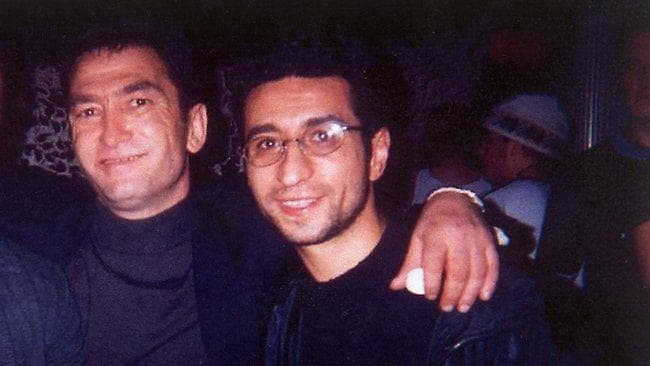
Nik Radev (left), with Sedat Ceylan, who he would later extort.

Born in Bulgaria in 1959, Nikolai “The Russian” Radev’s lifeless body lay on the street, seven gunshot wounds in his head and neck, an unbecoming sight for a man once labelled in an article in The Age to be “A middleweight drug dealer with a heavyweight ego”. So where did it all go wrong?

Radev arrived in Australia in 1980 with little more than the clothes on his back, and was granted refugee status. A wrestler in his native country, he had spent time behind bars, in one of the most notorious systems in Eastern Europe.

He made an honest living for the first two years he was in Australia, working at his in-laws fish and chip shop in Doveton, before opening a pizza shop in Dandenong.

Over the next two decades, Radev never worked a regular job or paid a cent in taxes, preferring to use his muscle to make a living.

Radev had no shortage of techniques to make money, but was fond of extortion and making threats to kill. It wasn’t uncommon for him to cross associates, claiming to be owed money, essentially putting a price tag on their lives, resulting in all too regular paydays.

His desire to intimidate knew no boundaries. The one-time suspect in the murders of Detective Gary Silk and Senior-Sargent Rod Miller allegedly later planned to kill a member of the organised crime squad. The now-retired detective’s parents were also threatened, with Radev walking into their hotel reportedly carrying firearms and hand grenades.

By the turn of the new millennium, Radev began to traffic heroin in St. Kilda and wasn’t shy about flaunting his wealth. A $100,000 Mercedes, Versace suits and a $20,000 watch (which he was wearing on the day he died), nothing was too flash for the man who had made it his life’s work to be a gangster.

It was inevitable that Radev’s lavish lifestyle was going to make him a target.

Radev rarely ventured out of his rented Brighton property unarmed. Perhaps through arrogance, mere stupidity of a lapse in judgment, that was exactly what he did on the morning of April 15th 2003.

After a meeting at the Brighton Baths, Radev was lured to Coburg under the premise of completing a lucrative drug deal, an offer that was too good to refuse.

Very little is known about what happened once Radev arrived at the intersection of Reynard and Queen. The lone witness at the scene told police they saw a red sedan, possibly a Holden Vectra, leaving the scene moments before shots were fired, at around 4.30pm.

Radev was considered a loner. He showered his wife and daughter with lavish gifts, but chose not to live with them, telling his wife shortly before he died that he married her in order to get Australian Citizenship. He didn’t have a close circle of associates to warn him that there were bullets with his name on them.

Radev’s death was a reflection of his life. He died alone, an unpopular figure of the Melbourne underworld. There was no crowd spilling out the church doors at his funeral, no gold plated coffin and no media fanfare.

Nearly sixteen years after his death, it is more likely that Radev’s name will be completely forgotten than it is likely that his murder will be solved.

Nik Radev, even at the peak of his powers, was little more than a pawn in a chess game he had no business being part of in the first place.